
When the summertime heat hits, homeowners rely on their household cooling systems to stay comfortable and safe. Unfortunately, an inefficient system can lead to wildly high energy bills that put a damper on your wallet. Attic insulation can be an imperative component for making your HVAC system more efficient during the hot summer months.
What Is Attic Insulation?
If you’ve ever crawled up in your attic to discover pink or yellow-like rolls of fluff material or loose fill, then you’ve seen a few types of attic insulation. This insulation serves an important role in providing a barrier between the indoor and outdoor temperatures. All insulation is given a rating known as an R-value; the higher the R-value, the more resistant the insulation will be to temperature changes. Each area of the country is given its own recommended R-value based on the region’s experienced temperatures.
Types of Attic Insulation
There are a few different types of insulation that you can purchase for your attic. Each comes with its own pros and cons, and some insulations tend to be easier to install than others in certain scenarios.
Batt Insulation
Probably one of the most common types of attic insulation you’re going to find is batt insulation. This will come in large rolls and can be referred to as a blanket or sheet insulation. With this type of insulation, there is a paper backing that works great for stapling the insulation in between rafters. This tends to be one of the most affordable insulation options, and you can find insulation made of plastic, fiberglass, or even natural materials like minerals or wool, depending on your needs.
Loose Fill Insulation
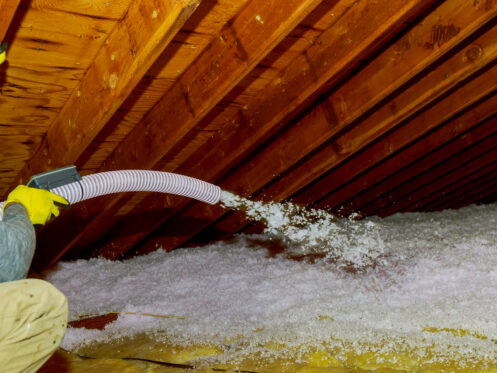
Also known as blown-in insulation, loose fill insulation is typically constructed of fiberglass, cellulose, or even rockwool. The insulation material is fed into a machine that’s specifically designed to blow it into a designated location in your attic. This type of insulation is best for putting behind supporting panels and walls.
Panel Insulation
An insulation option that is popular with new construction projects is panel installation. Typically sold in four-by-eight-foot panels, these can be cut to the specific size that you need for your attic. Also known as rigid panel insulation, this material is typically constructed of foam plastic like polyurethane, polystyrene, or even fiberglass. While panel installation is extremely energy efficient, it’s also one of the more expensive insulation options on the 2020s market.
The Main Benefits of Adding Insulation to Your Attic
While attic insulation is considered a standard construction practice today, it wasn’t as popular back in the 1950s. In fact, if you live in an older home that was built before the 1950s, it’s highly likely that you may not have any insulation at all. It’s a good idea to consider adding attic insulation to your home for many different reasons.
HVAC Energy Efficiency
One of the best reasons to consider investing in insulation for your attic is that it will help your HVAC system be more energy efficient. During the summer months, all the cold air that your air conditioning system produces can stay trapped in your home thanks to your insulation barrier. The same holds true in the wintertime when it comes to heating your home.
When you have insulation in place, you can be assured that all the air treated by your HVAC system can remain inside your home instead of escaping through your attic. Furthermore, attic insulation is great for keeping the outdoor air from penetrating your home. For example, in the summer months, insulation will keep the hot air from outside from penetrating your home and raising its temperature.
Enhanced Comfort
Another great reason to consider investing in attic insulation is that it will help to increase your family’s overall comfort in your home. You no longer have to worry about nasty drafts coming through. Rather, your home will be able to stay at a consistent temperature all year round.
Boosted Resale Value
When you make an investment in your home, you want to ensure that you get a return on that investment. Attic insulation is one of those rare home investments where you can get 90% or more of your investment back in the resale price of your home. Home buyers, especially those buying older homes, want to ensure that the home has adequate insulation so that their energy bills can be controlled throughout the year.
Make Your Attic Habitable
If you have a walk-in style attic, the space could be used to provide more living space for your entire family. Unfortunately without proper ventilation, it can be hard to maintain a safe and comfortable temperature throughout the year. However, when you put insulation in your attic, it can help to make it more habitable and add precious living space to your existing home.
Reduce Noise Pollution
One lesser-known advantage of investing in attic insulation is that it works to help reduce noise pollution. Whether it’s a heavy rainstorm pouring down or your neighbor’s dog barking extremely loudly, attic insulation can work to minimize that noise coming into your home. Furthermore, you can even upgrade your attic insulation to include soundproofing to help drastically limit the exterior noise coming into your home.
Prolong Your Roof’s Lifespan
A great advantage of having attic insulation in your home is that it goes a long way in extending the overall lifespan of your roof. One of the biggest causes of premature roof deterioration is excess heat in the attic. When it gets too hot, the heat will penetrate underneath your shingles and can cause them to curl.
How Often to Replace Attic Insulation
Just like every other building component in your home, attic insulation is going to have its own lifespan. How often you need to replace your attic insulation is going to highly depend on the type of insulation that it is. Typical batt insulation is going to last anywhere between 15 and 20 years.
Loose fill insulation can last anywhere between 80 and 100 years as long as it doesn’t become damaged. It is recommended that you have loose fill insulation checked by an insulation expert every 20 years to ensure that it’s still working properly. Lastly, foam board insulation can last a hundred years or more when properly installed.
It’s important to note that the above lifespans are just estimates. There are many different factors that are going to determine the overall lifespan of your specific insulation. Some of the most significant include your local climate, exposure to pests, humidity levels, and the quality of the installation job. Getting your insulation inspected regularly can help to alert you of when it’s likely going to need to be replaced.
Reliable Insulation Service
Universal Heating & Cooling offers reliable attic insulation service for the entire Dayton, OH community. We can also help with all of your heating, cooling, ductless mini-split, ductwork, and indoor air quality needs. Give our office a call today, and our friendly staff will set you up with a service appointment.